Se afișează postările cu eticheta Romanian myths and legends. Afișați toate postările

miercuri, 2 ianuarie 2013

Fantastic unsolved mysteries in the Romanian Carpathians


Whether you are a history and archaeology freak, or you simply like climbing mountains, in some areas of the  Romanian Carpathians you will meet some enigmatic buildings.

As we know about history, 2000 years ago the Romanian mountains were populated by Dacians, which have been conquered by the Romans. But what happened here before, which civilisations have settled in the area? Of course, unsolved ancient mysteries are not only in Romania to find, think about Stonehenge, Pyramids etc, to name just a few of other enigmatic areas, which are maybe even better knowned like the Romanian ones!
The former Capital of the mighty Dacian Empire is still hiding some mysteries

The fact, that many evidences and artifacts point to a revolutionary conclusions: before the dacians, in the Romanian mountains, were other civilization, which was advanced and able to do unbelievable works. Iconic historians called them Pelasges, while other scientists reject this theory!That's why I am going to present only the facts, which you can discover and see yourself.
Is the Sphynx from the romanian Carpathians hand made, or the result of natural erosion?

In the remote isolated area near Orastie (not far from Deva, Alba Iulia or Sibiu) you can discover one of the most iconic and enigmatic places in the Romanian mountains: the sanctuary from gradistea Muncelului. Here was the mighty Capital of the Dacian kingdoms, on 30 human cut terraces. Professional or hobby archaeologists discovered houses, workshops for metal and pottery, water basins, defending walls and ritual sanctuaries. In the middle were the tower houses of the Dacian kingdoms. The walls are more than two thousand years old and form an irregular quadrilater. The former Capital was stretching on 6 accres. Please observe that our ancestors did not build with stones from the neighborhood, as they was simply too soft. They brought stones from tens kilometers away. The food was also coming from remote area, and you can imagine the logistics and technical problems emerging. The Dacians used a special technique to build walls, called "murus dacicus", and the sanctuary found in the area show advanced knowledge of astronomy, technology and even medicine! The ancient Capital is not easy accessible, you have to walk two hours long from Costesti (where a cabin would welcome you).
Old maid chatting in the Bucegi mountains

Another enigmatic place is the Bucegi Mountains, on the Prahova Valley, easy to discover from Sinaia. There are some caves in the area where happen strange things, used to initiate the Yoga aspirants. And there also some interesting artifacts, the Sphynx and Babele. hard to say if they are hand made, or the simply normal result of the natural erosion. Watch them in nature, or in photos, and tell me your opinions!


miercuri, 26 decembrie 2012

The Salt Mountain from Slanic


Leaving Ploiesti towards Slanic and Valeni de Munte means to drive in a certain way out the beaten path. So, don't leave the city of Ploiesti to Campina-Brasov, or Campulung-Brasov, and neither towards Buzau-Focsani. Please take care a lot to the indicators, maps, GPS, as otherwise you'll be in serious troubles!

Only 40 km away from Ploiesti, in a majestic landscape, the resort Slanic welcomes its visitors with rowing white firs, but also with one of the oldest salt mines of Wallachia, opened already from the XVIIth century. When the exploitation begun, there were actually two salt mines, but along the years one of them collapsed inside forming Baia Baciului/ The sheepherd bath. The precipice filled with water , resulting in the swimming pool you can see nowadays!
Typical house from Slanic

But in Baia Baciului another surprise is obvious: due to collapse of the first salt mine, the soil above the other mine has been removed and an entirely salt mountain emerged to the surface. It is an amazing view, looks like a giant crystal with cutting edges, changing color in the sunlight.

Inside this mountain, the mine filled it with water, building The Bride Lake. The legend says that a local girl comited suicide here, after her parents forced her to marry a boy she didn't love. The salt water pushed her to the surface and kept her there, but she died nevertheless due to the strong impact (he falled from a high rock).
The old salt mine from Slanic is excellent for fighting lungs diseases, due to the constant temperature

Unfortunately, only a few years ago, another part of the salt mountain collapsed, and the Bride Lake lost its fame. But the place deserves nevertheless a visit due to the strange bizarre aspect. You can take an excellent bath in the lake, don't forget your suits.

Visit further in Slanic the Salt Museum, as also the old mine, and continue your trip to Valeni de Munte, a small but interesting town, having many to reveal to any visitor. Nicolae Iorga, one of the most distinguished Romanian scientists ever, has lived here for 40 years, and his house is nowadays a Memorial, where you can admire fine paintings, and unique pieces of furniture, with a popular inspiration. Next to the Memorial house, a collection of church works of art, with a focus on icons and books from the XVIIth century.
Please notice the lake from Slanic with its amazing neighborhood, and finally take a good bath 

If you are rather interested on natural phenomena, direct to Cheia, and meet a very special thing: The Green Mountain. It consists on rare soft volcanic rocks, and the locals use pieces of it to obtain a special ornamental mortar, which you can observe to the most of the fences and houses.

joi, 13 decembrie 2012

The romantic secrets of Varatec Monastery


The Romanian people have for sure a religious vocation, I think that the number of churches and monasteries is bigger than what you can find in other countries. Please correct me if I am wrong!

Making donations for a monastery, or much better, building a monastery, was for any wealthy Romanian the best way to gain social recognition, and most of them kept long time alive this tradition. Thus, many of the monasteries are rich, have lands, forests, art works etc. For a good cause, because the Orthodox church has a pregnant social mission, when not turning in a concern, due all its properties.
The Agapia monastery is a bigger, richer sister of Varatec

Only 40 km away from Piatra Meamt and 8 km from Targu Neamt, on the road leading between these towns, you can the wonderful monastery of Varatec, which is nice, sunny and only 200 years old. It was grounded by the daughter of a priest from Iasi. Entering the monastery you will be charmed by the richness of flowers and the tidiness. The nuns must be very aplicate, and they have also an efficient management.
Veronica Micle has been for years the inspiring lover of the Romanian national poet, Mihai Eminescu

The Church of the Monastery is a worship with two towers, whose roof is bell formed. From a strictly administrative point of vue, Varatec has the same management with the nearly Agapia, which is much bigger and better renowned due to the original painting made by Nicolae Grigorescu, the most important Romanian painter, whose masterpieces are very expansive nowadays (an excellent investment).

In Varatec the painting was made at 1840 and remade 40 years latter. The golden rood screen is simply breathtaking, beyond the religion matters. Simply a masterpiece, I hope you will agree! The Museum of the monastery mirrors the richness of the administration ( at 1850 the monastery possessed 4 churches, 17 bells, 700 nuns and an important yearly earning). Thus, the museum will proudly show you rare books and short editions, priceless icons, church suits etc ( only a part are donations, the monastery owned many workshops).
Spending vacations in isolation at Varatec was very frequent among the  local  aristocracy in the XIXth century

Discover further a smaller church, carrying the name of St John The Baptizer. Besides, a small white grave stone hides a very romantic tragedy, ending at 1889. Inside the grave rests Veronica Micle, the inspiring lover of Mihai Eminescu, the most important Romanian poet. After Eminescu died at 1889, Veronica Micle searched in Varatec shelter, silence, trying to forget all disappointments. He didn't succeed, and died in the same year, committing suicide with overdose of arsenic!

marți, 11 decembrie 2012

Myths and legends about Maramures


Maramures lies in the extreme North of Romania, and is very attractive, proudly welcoming his honored guests. This country of Maramures is very particular in Romania, and you can discover it starting from Baia Mare and travelling all around.

This Mystery Land is actually an eagle  nest build on the mountain rocks. The natural beauty of the places is overwhelming, and the people have sometimes savage or suspicious faces, until they talk and adopt you (guess the next step, it is for sure an invitation to drink tzuica, horinca or palinka, local names for plum brandy. Don't be very happy accepting, it is difficult to face such an important test and must behave properly. You must know from the beginning, that the locals are very well trained.)

There are some easy visible contrasts in all these area. Observe the wooden churches, they are simply unique and note the inside paintings, devoted to Jesus Christ, but carrying Pagan symbols, like The Sun and The Moon. Also, on the monumental wooden gates, observe and note the tree of life! Most of the local cars are very modern, and have foreign plates from Italy mainly, as the youngsters work there to earn some money, while the women still wash their wool blankets in water mills, as their ancestors did a few centuries ago. Maramures is definitely a magic place, where the modern times face with the traditional archaic ones, but have no chance to win.
The wooden church from Barsana, Maramures is really a masterpiece and the highest in the area (75 meters)

The climate in Maramures pretty cold, and specially during winter you must be good dressed ( don't think to dress code or etiquette, you must be well protected against cold ). The surrounding mountains build a natural fortress, explaining the differences comparing to other regions in Romania and the special character of the locals. Up to 1950 was practically impossible to reach Maramures by train from Romania, it was necessary coming over Czechia!

Due to this isolation of Maramures, after Romans conquered Dacia, the still free Maramures was a good shelter for the fugees of other Romanian regions. It is said (local legend from Rozavlea) that Maramures was populated in the good old times by giants. As the time gone away, only one giant remained, and he was very old, but had a young daughter, the pretty Rozalia. Once, walking of the Valley of Iza, Rozalia saw a few small creature, and she didn't know who were. She collected a few of them, and ran to her father to show him. The old wise giant talled her, that these dwarfs are the Romans who shall conquer and run Maramures in the future. Consequently, Rozalia prayed God to make one of them bigger, and her smaller. This fact came true, and so appeared the Romanian people of Maramures!
The wooden gates from Maramures are a landmark. The bigger the gate, the richer the master.

Exploring Valea Izei is easy by car, the road is good, just a little narrow and dangerous, because the locals don't fear anything, including cars! But if you are there on a feast, or during a festival, you will be very happy. The people still wear their ancient suits, bleach the wool in the water mills or spin it.

On the Iza River, in Barsana, Stramtura,, Rozavlea, Bogdan Voda, Ieud you will find the amazing wooden gates, which are not a sign of competition against other community members, but also a remember of the ancient Roman buildings (see the Arch of Triumph in Rome!), in my humble personal opinion.

Don't miss in Maramures  Sighetul-Marmatiei with the impressive Memorial of the Victims of Communism ( due to the isolation, here was a jail where the communist regime let many of his opponents to die) or with the Village Museum, which is a replica of an old village with its obsolete techniques. And a little further, the Happy Cemetery of Sapanta, where a local artist wrote on every cross something special for the deceased, which is usually very brisk!

Within the isolated Maramures, the people are still proud to wear the popular suits


vineri, 16 noiembrie 2012

How to discover the Romanian Monasteries from Oltenia


The Romanian monasteries are build from stone and faith. The Romanian leaders wished always to engrave their faith in wood or stone, building churches and monasteries whether next to their residences, or in secret retreat places, good for meditation. The painted monasteries from Bucovina attract many tourists, while the monasteries from Oltenia are unfair neglected.
The Cozia Monastery is very nice, very quiet and meaningful for any Romanian: here is buried Mircea cel batran.

But beween Ramnicu Valcea and Targu Jiu, in the superb hilly region of Northern Oltenia  the Romanian rulers Mircea cel Batran, Matei Basarab, and Constantin Brancoveanu build monasteries. A special mention for Brancoveanu, an excellent diplomat who was able to keep Wallachia in peace for a long period. Thus he contributed to the exceptional cultural development of Wallachia during the XVIIth and XVIIIth century. He also created a personal charming architecture style carrying his name, by mixing the Italian Renaissance with baroque and Serbian or Byzantin influences.
The Govora monastery, very close to Ramnicu Valcea

You can discover the Monasteries of Oltenia starting from Ramnicu Valcea, on the busy DN7 leading to Sibiu, along the River Olt and the spectacular gorges of Turnu Rosu.

Discover first the Monastery of Cozia, a discreet hidden apparition between the noisy highway and the River Olt. It was buil at 1387 by the ruler Mircea cel Batran, who is buried here. The church has been build by Serbian masters from Moravia,, concentrating a wide palet of ornamental works. Constantin Brancoveanu added at 1707 the painted rood screens. Pleaes observe the painting of the grounder and the details of his clothes. Discover further the buildings from different ages and the small museum.

Drive through Ramnicu Valcea on DN67  following the Govora Monastery, build by Matei Basarab at 1640,  on the place of an older church. Matei Basarab also put here in function a printing shop, one of the first in the Romanian countries. The church is surrounded by flower, and also by solid walls. The rood screen is charming for real!
The Monastery Dintr-un lemn  is far way from any port or airport, but in a misterious way protects airman and seaman!

The monastery Dintr-un lemn ( meaning from Romanian 'from a single piece of wood) is pretty isolated, but very solid (its name is a guarantee for that). The interior is very protective, warm and familiar. Amazingly, based on an unknown reason and myth, this church protects the seaman and the airman!
The Horezu monastery and the charming Brancoveanu Architecture style

Don't forget in the area the famous vineyards from Samburesti and Dragasani, but you have an other important target, the Monastery Horezu, the pearl among all these monasteries from Oltenia! The land scape is extraordinary, and you must enter an yellow wooden door. It is the masterpiece of Constantin Brancoveanu and an UNESCO heritage. The church is in the centre of a big yard, closed aside by Monastery builing with big carved columns. Recognize and enjoy the Brancoveanu Architecture style through the perfect harmony between its proportions and the discreet ornaments. In this breathtaking church dreamt brancoveanu to stay in the ethernal sleep, considering the monastery as his last will in stone and faith.

sâmbătă, 10 noiembrie 2012

The best 5 ski resorts in Romania


When I say you can do everything in Romania, I really mean it! Maybe some of us are already aware, Romania is a target for the winter. The Romanian Carpathians, in a certain region well known as the Romanian Alps, cover one third of the country.

There are a lot of possibilities of walking, climbing, hunting in these mountains, which are not so high as the Alps (highest peak in the Romanian Carpathians  is Moldoveanu, 2550 meters, easy accessible for a normal trained traveler.) Maybe not so spectacular like Mont Blanc, the Romanian Carpathians are covered with forest, very well populated with wolves, deers, bears etc. The last European virgin forests are to find in Romania, where else?

But let's limit to the winter sports freaks and spoil them. They ski, skate, sleigh and bobsleigh. When is summer in the Northern hemisphere, they head south in the Andes. They are amazing, these peoples: they really enjoy life, are very fit and stay on the slopes until night falls, making unorganized parties. Wonderful life indeed.

I invite all these winter sports freaks and afficionados in Romania, where I selected a few ski resorts able to organize a good vacations for them. So, this is my personal rankings:

1.Poiana Brasov
The winter in Poiana Brasov is really an event, and not anybody can afford it

Only 50 years ago on these wonderful places and mountains there was nothing, but the forest. Lieing 10 km from Brasov away and 150 from Bucharest, it is a main target on weekends even among Romanians. The foreign travelers are also delighted by the many slopes with different degrees of difficulty, the good hotels and restaurant. But you must take care to the budget, Poiana Brasov is expansive.
2.Predeal
Predeal has a long tradition in winter sports and usually a lot of snow

Predeal is much older and has a good tradition in winter sports. Very close is also Sinaia, with other slopes, so the forecast is simple: if we don't find snow in Sinaia, than we shall find in Predeal. Thus, everybody is really happy.

Important remark: you can reach Sinaia, Predeal, Poiana Brasov from Bucharest on the A1 highway, but you must avoid driving from Bucharest on Friday afternoon, and also driving towards Bucharest on Sunday afternoon, due to the huge aglomeration caused by the week end rush.
3.Paltinis is very close to Sibiu, very nice and picturesque, but seems to be a little neglected. Nevertheless, has everything necessary for a quality skiing and a wonderful time.
Paltinis is nice and traditional, but also very affordable

4.Ranca is much newer, the newest actually, being heavily promoted only since a few years, together with Transalpina mountain highway. The acces is difficult in winter.
Ranca is easy reachable from Targu Jiu, but sometimes in winter the access is almost impossible due to closing of transalpina highway

5. Borsa, Maramures is also still young and also good for  beginners. This is a rising star, slopes for trained skier must come soon.
Borsa is the rising star of the Romanian ski resorts


joi, 8 noiembrie 2012

Shopping travel in Romania


Very few people see Romania as a shopping destination, and I think this to be a little profuse and not correct. Romania is well known through its wine tours, Danube Delta, Carpathian Mountains, painted monasteries etc. There is something for sure, but we are very proud belonging to this people with such a long interesting history, and don't like to stay behind other capitals with big shopping malls and center, e.g Dubai, Paris or Rome.
Calea Victoriei in Bucharest hosts the most exquisite boutiques, and would be very proud welcoming you

Bucharest is sometimes spoiled with the name  Little Paris, or Eastern Paris, or the Balkan Paris, due to the rich influences in architecture, coming from Paris, who was a sort of inspirating model for the Romanian Capital. In the Civic Center, on Calea Victoriei street, there are lot of fancy exclusive boutiques, where you can find excellent articles at (still) acceptable prices, comparing to other capitals. Further, in Bucharest, you can find the malls, really citadel of shopping and fun (Cotroceni Plaza, Promenada etc). You can spend a wonderful time there, for instance start with skating, eat something afterwards and go shopping. If you are tired, go to a movie, and fall asleep there!
Cotroceni Plaza Mall is the biggest in the city, a must see and  a paradise for any shopping freak

An important chapter where Romania is unbeatable is the craftmanship. You can still find all those guilds of craftsmen, selling their works at festivals or in the vicinity of well knowned tourists' destinations, like the painted monasteries from Bucovina or the Dracula Castle in Bran.

I will spare you from my wine or cultural tours if you come for shopping, I promise. That's why I prepared this short shopping tour (two days long).
Downtown Bucharest, on Lipscani street, with many antiques  boutiques

Day 1. Arrival in Bucharest Airport. Welcome by the guide, hotel transfer (**** good hotel). Shopping on Calea Victoriei in the most exquisite and sophisticated boutiques of Romanian Capital up to 13 hours. On special demand, lunch in a good Romanian restaurant. Short walk in the old center of Bucharest in selected antiques boutiques. Short rest in hotel (1 hour long) and afterwards transfer at Cotroceni Plaza Mall, where you have to work  other few hours. Dinner on individual wish at mall. Transfer back to hotel.
Day 2. Breakfast in hotel . Short trip to Sinaia meeting the craftmen and their products. Possibilities for special organizing of lunch in Sinaia (extra price). Return to hotel and transfer to airport.
Basic package: hotel B+B, travel guide, transfers, trip to Sinaia at 120 Euros.
According to your concrete schedule (depanding on depart and arrivals) the above mentioned program is subject to change. Let me know where do you come from, and if I shall reserve also the flight.

You can also let me know if you are going to do only a City Break in Bucharest (only one day long).

miercuri, 24 octombrie 2012

Romania for honeymooners


Unfortunately, Romania is not seen as a destination for for honeymoon. It is not right, it is not correct, and it is not true, and I will explain why. Please,reconsider your approach seeing Romania as an important destination  for your honeymoon.
Maybe you'd like to be bride in the Romanian popular dress, which is very rare and exotic even among the Romanian brides nowadays

First of all, you can make your wedding here, in an orthodox church, goes so deep inside! It is touching indeed, and lasts 2 hours. For the non-orthodox would be a problem, they need prior to baptise, which is a separate ceremony, and is practically impossible to have both in the same day! But doing this you will feel yourself filled (remember from the Greek, orthodoxia=right religion!) and doing this you will have a perfect balance between mind, body and saw!
I wish you to have such a huge wedding as the daughter of the Romanian President Traian Basescu (here in the churc, during the religious ceremony)

After the religious marriage, or even prior, bag you pardon, you need the civil ceremony, when the Mayor shall pronounce you man and wife for the rest of your lives, no matter how long it seems nowadays! At evening, the feast, lasting all night long, because all the friends and relatives would like to take part and celebrate! Be sure to order more sorts of wine, in big amounts. Be sure to dance a lot, having a good orchestra, and be sure to have a wonderful time. It is unforgettable for the bride and the gloom, an important day of their lives.
Honeymoon on wine tasting, why not? Romania's many vineyards will facilitate a long exciting trip

After that you might need a day for rest, and afterwards you need some privacy, find a place for your own! The gloom must be a wine afficionado, I am very sure; and if the bride shares the same passion, we can have wine tasting a milestone for your original honeymoon. In this wonderful season, a long Autumn, I am going to organize special wine tasting of Muscat Ottonel and Feteasca Neagra in vineyards, staying there in the manors! Remember that Feteasca from Romanian means young girl wine, and make distinction from babeasca (old maid wine). I am going to spare you during the honeymoon from Babeasca, you won't get any drop.
An isolated cabin in the mountains is a good option for honeymooners

Another possibility is going in an isolated chalet in the mountains, where you can get all the intimacy you need. Keep writing there in your book of souvenirs for the latter years, make short walks. You are a small piece in a puzzle, which is your Earth and the Universe. Most important, stay in peace and harmony with the Universe, maybe you will experience even tantra!
Travelling on a ship on honeymoon is like a dream coming true

Also recommendable for honeymoon in Autumn: a trip in Danube Delta, starting from Tulcea, of course. Very relaxing and romantic indeed to discover other living creatures of the Universe. And from time to time you can go back in your heated cabin, under the deck!

sâmbătă, 6 octombrie 2012

Enter Romania, visiting Arad


If you come by car to Romania from West there are big chances that the first city you meet is whether Arad or Oradea. Meeting anyone of them means an excellent publicity for Romania, they are nice, clean, peaceful, and very similar in many directions, but with a little advantage for Arad.
I you enter Romania coming from the West, and the first important city you meet is Arad, you may have an excellent first impression about this country

Arad lies in a plain and proudly counts 150000 inhabitants (20 % Hungarians) is a major target for foreign investments and enjoys a certain prosperity (the Romanian president Traian Basescu is the Godfather of the Mayor of Arad, only one of the possible explanations). Amazing in Arad is the Center, on Bulevardul Revolutiei, when you can see many old buildings, Secession style, like the City Hall, Catholic Cathedral and even the Railway station. Also a monumental Orthodox Church still in building state.
The magnificent Evangelic church from Arad, buid in Secession style, on the place of the former  fortress of Arad. Nowadays, Arad is among the few cities from Transilvania which haven't a fortress anymore.

Amazing in Arad is the evolution of the population: in 1712 when Hungarians beat the Turks, conquering the city, 60 % of the population was Romanian. In 1918 Arad and the rest of Transilvania unified with Romania, and the last known census from the Habsburgic times, namely from 1912, counts more than 70 % Hungarians. Strange, isn't it?

On the nice peaceful Bulevardul Revolutiei I have been honored to be the guest of Hotel Continental Forum Arad, the city's biggest and best, with a group of happy tourists from Norway from PR Norge, on behalf of Karpaten Tourism. Next day I was supposed to leave very early, at 6: 30, but through the devoted work of Mr Dumitru from the kitchen I did not leave the hotel hungry!

Very particular for Arad, comparing with other cities from Transilvania, it has no fortress. It was a fortress for sure, build after the Mongol invasion from the 13th century, but meanwhile totally destroyed. On the place of the fortress you will find the magnificent Evangelic Church. But there are strong compensations, and only 30 km away in Minis there is a vineyard specialized in Reds, specially Merlot!

vineri, 5 octombrie 2012

Must see in Romania: Cluj-Napoca


Cluj-Napoca has been for years the official capital of Transilvania, a province in the former Austrian-Hungarian Empire. Today, not so officially anymore, this city enjoys the same status.
The Orthodox Cathedral of Cluj-Napoca, with the Monument of Avram Iancu, a Romanian hero

Discovering Cluj-Napoca from any direction is an event for your eyes. You come from the mountains, and you see from distance the city, in a depression. You will admire it at once and fall in it, wishing to know everything possible about this city, one of Romania's most beautiful . Comparing it with Bucharest with its eclectic architecture is in the clear advantage of Cluj-Napoca (German Klausenburg, Hungarian Koloszvar). In the centre, Cluj Napoaca acts very Central European, similar maybe to Budapest.
The Hotel Continenta, also known as New York Palace, is an architecture jewel in the centre of Cluj-Napoaca

Cluj-Napoca has a huge scientific and cultural potential. The actual leader of the Romanian Academy is born in Cluj-Napoca and made here his researches. Cluj-Napoca, also known simply as Cluj, is the main target of the foreign investors in Romania, after Bucharest. There are plans to develop Cluj Napoca to the unbelievable level of 20 Millions inhabitants within next 50 years. The people in Cluj Napoca (nowadays 20 % Hungarians) are usually high educated, very serious, respecting there words. It is not very easy becoming friend with these people, but once you have their confidence, be sure to receive a dinner invitation, where you will able to enjoy palinca (plum made strong brandy), good wines and sarmalute. Despite the cosmopolite aspect of the city, the people don't forget their roots and traditions.
City Hall from Cluj-Napoca is another monument of architecture

Entering Cluj-Napoca you will notice first the most modern buildings from the last 20 years, some ruinated industrial factories from Ceausescu time and even the communist blocks which the inhabitants dream to leave (but of course, not all of them can afford to do it). Going further, deeper in the city's heart, you will discover the amazing center, with the Catholic Cathedral (St Michael's Church), hotels and restaurants, cafes and museums. Visiting it during the peak hours with a group of Swiss tourists from Twerenbold on behalf of Karpaten Turism was very nice, but I couldn't organize a lunch because all the restaurants were overcrowded. That means a big city indeed.
The Catholic Cathedral of Cluj-Napoca

Special mention for the riding statue of Matthias Corvinus, former ruler of Transilvania. The Hungarians say he was Hungarian, but the Romanian say also he was Romanian, or at least to have a Romanian origin. Not so important anymore, the mutual relations start to improve.
The Synagogue of Cluj-Napoca is an historic building, but Jews are unfortunately not anymore to find in Cluj-Napoca

joi, 27 septembrie 2012

The fortresses from the heart of Transilvania


Transilvania is an important consisting part of Romania, a little bigger than the third of the country.Very nice, very civilised and western oriented, a proud of all Romanians.
The Carnival in Sighisoara is probably the best place for starting the discovery of Medieval  Transilvania

It has a trembled history, and in Middle Age has been ruled by Hungarians, who brought German Saxons for help in organizing and defending the country. The German Saxons (Franken actually) build every settlement on the same blueprint: a central citadell consisting of a fortified church, where all the people should withdraw and fight against the invaders during long sieges.
Eating in Dracula house is nowadays a peaceful event, who doesn't scare anyone. But all the meals are garlic based, in order to keep the bad spirits away.

In the middle of the Romanian Transilvania there are 700 very well preserved medieval sites, forming an amazing UNESCO inheritage . With a group of Norwegian tourists lead by Kjell and F1 driver Oivind from PR Norge and on behalf of Karpaten Turism  we drove four days long to discover the forgotten Paradise from Middle Age.
The man in this photo is Serge Gunnar ( a sultan with Asian and African ancestor.  A fine friendly man, whose friendship I am honored to have became)

Sighisoara is doubtless the peak of all Medieval fortresses from Transilvania. Because the town only counts 20000 inhabitants, the life even today is organized around the citadell. There are many Medieval Festivals to the delight of  the tourists and locals. It is normally in Sighisoara walking on the streets in the complicated evening gowns from Middle Age. In the Dracula house there is today an excellent restaurant, making sensational dinners with lots of garlic, specially for avoiding the bad spirits. From the town very many hotels and restaurants we made the best possible choice: Binder Bubi *****, which was an excellent host and we regretted very much when we had to leave.
Norwegian tourists in the citadell of Sighisoara; you can see the  clock tower

But only with the consolation to stay three days long in Binder Bubi Medias ****! Still try to understand this difference of one star, and did not succeed, as this hotel has the same high quality standards from Sighisoara, and even a swimming-pool, which is not available in Sighisoara. Medias is twice so big than Sighisoara, but has not such a tourist circulation. Or, maybe, being so big, the touristic circulation is not so obvious! Every little streed from Medias was in reparation, the town very dusty and dirty, but worths a long stay! From Medias we visited also Sibiu, gone to a winetasting in Ganesti/Seuca. It is to mention in Binder Bubi, both Medias and Sighisoara, the house wine, which is very good and only costs 18 RON ( no matter if the Red Cabernet or the White Sauvignon! With your permission Serge Gunar, and of all ladies around you)

A good friend and a good driver was always Oivind; here working in the yard of Binder Bubi Sighisoara.

miercuri, 5 septembrie 2012

Romanian Wine Cocktails


You must know and be aware of the wine based cocktails, as you may know as professional or simply skilled wine fan. I am also very fond of cocktails, and other mates of me here in Romania also do! We make them mainly, but not exclusively, during hot summer days, when it is not allowed to drink the wine dried or at room temperature, as the sommelier recommend!

We use here in Romania as cocktail bases natural sweet wines or sweet liqueur wines, and you must know some great wines as Porto, Madera, Marsala, Jerez, as also some other grand vins or grand cru. It is also possible to use Champagne for the cocktails, I am sure you already know this trick.  I adapted the receipes you know to the Romanian particular conditions, getting some amazing results, which I would like to share with you.
During the summer hot days it is not advisable to drink wine dried.

1. Cocktail Busuioaca
Use the following ingredients:
-ice cubes, the half of the shaker
-60 ml fresh orange juice
-30 ml fresh lemon juice
-100 ml Busuioaca de Bohotin
-1 teaspoonful of white rhum

Mix only by hand, well agitating the shaker, until you get an homogenuos drink, and add last the rhum, for a guaranteed success. The result is a long drink, tasting sweety and fruity.
Red wine based cocktail, the wine is Feteasca (girl wine). Indicated for ladies, if drunked by the men!

2.Cocktail Cotnari
Ingredients:
-ice cubes, 1/4 of the shaker
-20 ml exquisite cognac
-20 ml Curacao orange
-60 ml Blanc Cotnari (made by VINARTE SA)
-2 traits Angostura bitter
In order to get a refreshing long drink, you only may to mix 5-6 seconds long
White wine and orange cocktail, with a lot of ice, of course

3. Cocktail Dealu Mare cooler
-ice cubes, 1/4 of the shaker
-20 ml lemon juice
-20 ml exquisite cognac
-100 ml Feteasca Neagra from Dealu Mare (dark red wine)
-complete with soda or sparkling mineral water, or even with ginger ale or lemonlike drinks ( taste matter).
Stir for 10-12 seconds long and get a long soft drink, and decorate with a lemon spiral.
Which is your poisson?


Tell me please your opinions and other receipes or secret tricks you may have.

vineri, 24 august 2012

The Romanian Mountains


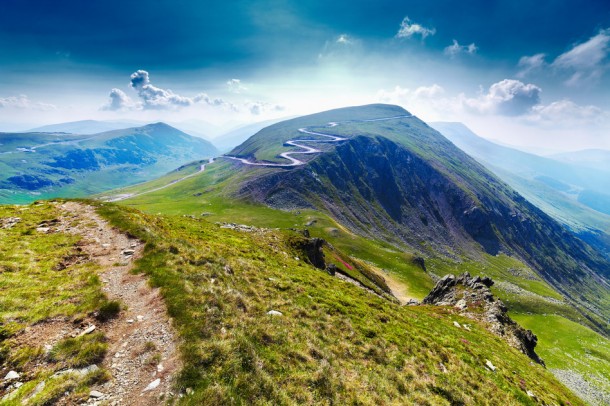
The Romanian Carpathians are young and strong, but nor very high comparing to the Alps. The highest Romanian Peak, accessible from the Transfagarasan Road, is Moldoveanu and proudly measures 2521 meters. Climbing it you can feel literally with the head in the clouds, as the Romanian say for pie-eyed people. The ascension is not very difficult, you don't need an oxygen mask, but need nevertheless to take some precautions.
The Peak Moldoveanu  is the highest in Romania and the most spectacular. Not very difficult to climb, but you need nevertheless some precautions. Most important: don't drink wine while climbing!

Maybe Moldoveanu is the most spectacular Romanian peak, but the Romanian mountains, whether lived or savage, are a must for the people who appreciate that and look for adventures. They are usually full with forests, despite the massive cuts from the last years, and you can find many labelled paths, for your delights. There are also many cabins, some of them neglected and very primitive, while others are unexpected luxurious and expensive, judging the environment. In the Fagaras mountains, near the Transfagarasan Road, you can find in winter even an ice hotel. Staying there is a matter of taste indeed.
If we shall speak about the Romanian Carpathians, I won't forget to mention the terrific Transalpina Road

You can also observe the charming Romanian Carpathians from the car, or the bus, during a trip on the fantastic Transalpina Road, Bicaz Gorges, Suceava-Bistrita, or Rucar-Bran. Amazing in some areas, you will be able to observe the Millenial unchanged way of life of the shepherds, who climb the mountains in Spring with their flocks looking for good grass, and return only in autumn. They are stone strong, don't suffer on stress or depressions.
Lepsa in Vrancea County

Some mountains areas have developed themselves through building many pensions for the touristic crowds, and I must name a few: Bocovina, Rucar-Bran, Tara motilor in the Apuseni Mountains, or Lepsa in Vrancea county.( wine tasting in Focsani, Panciu, Odobesti is a must)

A necessary mention for the Dobrogea Mountains, who will make you a sad philosopher. They measure only 700 Meters height nowadays and you can climb them very easy, but in their times of glory were higher than the Mount Blanc. Much older than the Carpathians, they are almost completely eroded now. Nearby, the vineyards from Niculitel.
Apuseni Mountains offers some unique landscapes

There are many things to do in the Romanian Carpathians, and you can get some magnificent landscapes with your camera. But during the climbing is not allowed to drink wine, don't forget. You can ask any further details at dorugiu@gmx.net, I still have some discounts for September.
Google+