Se afișează postările cu eticheta sophisticated dinners. Afișați toate postările

joi, 8 noiembrie 2012

Shopping travel in Romania


Very few people see Romania as a shopping destination, and I think this to be a little profuse and not correct. Romania is well known through its wine tours, Danube Delta, Carpathian Mountains, painted monasteries etc. There is something for sure, but we are very proud belonging to this people with such a long interesting history, and don't like to stay behind other capitals with big shopping malls and center, e.g Dubai, Paris or Rome.
Calea Victoriei in Bucharest hosts the most exquisite boutiques, and would be very proud welcoming you

Bucharest is sometimes spoiled with the name  Little Paris, or Eastern Paris, or the Balkan Paris, due to the rich influences in architecture, coming from Paris, who was a sort of inspirating model for the Romanian Capital. In the Civic Center, on Calea Victoriei street, there are lot of fancy exclusive boutiques, where you can find excellent articles at (still) acceptable prices, comparing to other capitals. Further, in Bucharest, you can find the malls, really citadel of shopping and fun (Cotroceni Plaza, Promenada etc). You can spend a wonderful time there, for instance start with skating, eat something afterwards and go shopping. If you are tired, go to a movie, and fall asleep there!
Cotroceni Plaza Mall is the biggest in the city, a must see and  a paradise for any shopping freak

An important chapter where Romania is unbeatable is the craftmanship. You can still find all those guilds of craftsmen, selling their works at festivals or in the vicinity of well knowned tourists' destinations, like the painted monasteries from Bucovina or the Dracula Castle in Bran.

I will spare you from my wine or cultural tours if you come for shopping, I promise. That's why I prepared this short shopping tour (two days long).
Downtown Bucharest, on Lipscani street, with many antiques  boutiques

Day 1. Arrival in Bucharest Airport. Welcome by the guide, hotel transfer (**** good hotel). Shopping on Calea Victoriei in the most exquisite and sophisticated boutiques of Romanian Capital up to 13 hours. On special demand, lunch in a good Romanian restaurant. Short walk in the old center of Bucharest in selected antiques boutiques. Short rest in hotel (1 hour long) and afterwards transfer at Cotroceni Plaza Mall, where you have to work  other few hours. Dinner on individual wish at mall. Transfer back to hotel.
Day 2. Breakfast in hotel . Short trip to Sinaia meeting the craftmen and their products. Possibilities for special organizing of lunch in Sinaia (extra price). Return to hotel and transfer to airport.
Basic package: hotel B+B, travel guide, transfers, trip to Sinaia at 120 Euros.
According to your concrete schedule (depanding on depart and arrivals) the above mentioned program is subject to change. Let me know where do you come from, and if I shall reserve also the flight.

You can also let me know if you are going to do only a City Break in Bucharest (only one day long).

vineri, 2 noiembrie 2012

Ploiesti, the Romanian Dallas


There are good chances to miss Ploiesti if you go from Bucharest to Brasov or the rest of Transilvania and are in a hurry. It would be such a pitty, although the city of Ploiesti is not charming from the first sight and does nothing special to attract the visitors. You can miss the city of Ploiesti, but you can't miss its smell and the ever burning fires from its refineries.
The Culture Palace in Ploiesti holds more museums.

Ploiesti was found in the late XVIth century and within short time became a prosperous and animated trade and craftsmen city. In the XIXth century due to the oil reserves and massive investments from America mainly, the city had a rush development (but let to the Capital Bucharest the honor to be the first city worldwide using public gas light!). Anyway, the city proudly counted in 1914 already 10 refineries. These refineries showed also their bad sites during the WWI and WWII: the city of Ploiesti had a strategic importance and thus was one of the main targets of the aircraft bombings.
The unique Museum of the Clock in Ploiesti

Due to the huge oil discoveries from the Middle East lost something from its importance, but is still a quick developing city. Its position, 60 km away from Bucharest and 40 km away from the country's main airport confers so many logistic advantages. There are still a few refineries in the city, using mainly imported crude oil, an Oil University and even an Oil Museum ( a must see in Ploiesti). In the Oil Museum you will be able to observe the natural pride of the locals in this field, where they think to be ( almost) unbeatable.
Downtown Ploiesti with its old architecture style

Another interesting asset in Ploiesti is the Clock Museum. A watch, or a clock, measures something untouchable. The time does not exist for real, was the discovery of the notorious teacher Nicolae Simache, who started collecting watches. The Museum is unique in Romania, maybe also in the all world, and you can see simple cheap watches, or sophisticated watches and clocks, watches who belonged to prominent personalities etc.
This part of Ploiesti is not so nice anymore, very similar with other industrial  cities all over Romania

If you are tired, take a walk in the center or to the animated market. You can have your simply unexpansive lunch in a popular restaurant, asking about Meniul zilei, but you can also go in upscaled restaurant like Forum, where the prices are still to accept in this dear city!

joi, 6 septembrie 2012

Romanian gastronomic specialities

Romanian gastronomy is very rich indeed, and this is one of the many arguments for  taking  the decision to offer you exquisite food and wine tours here in Romania. The Romanian gastronomy is also not very original, due to successive  historic influences coming from neighboring Empires (Russian, Turkish, Hungarian and German).
The Gulash is rather Hungarian, no matter, you can eat exquisite Gulash in Romania

In Transilvania you can find very spicy paprika or gulash ( a tasteful spicy mix of meat pieces with sauce). In every corner you can find Kraut mit Wurst (German for cabbage with sausages!) with its local variation "Varza a la Cluj" (Romanian for " Cabage a la Cluj"). Cabbage a la Cluj is mixed with mincemeat and rice.
Varza a la Cluj pairs excellent with a red strong wine, as you can notice!

In Dobrogea you will be able to find the traces of the Turkish kitchen, mainly by the deserts like saraili and baclava! About the musaca (Romanian for Moussakka), it is much better represented Romaniawide, consisting of alternative layers of potatoes thin slices and mincemeat. You may observe, please, that the Romanians eat mainly pig meat, and there is an historical explanation even for that: during the Turkish occupation, the Turks took practically everything better, but they never enjoyed pig, as not recommended by their religion.
Baclavas are Turkish, and are very tasty.

Romanians were a few hundreds years ago mainly a shepherd people, and as a remaining they eat nowadays cheese at almost every meal. One kilo cheese costs 3 Euros, and a kilo tomatoes 0,8 Euros, and so you have a good idea for your menu if you are on a budget.
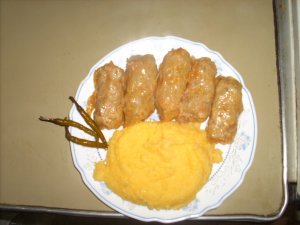
Sarmalute (  forc-meat rolls in cabbage sau vine leaves ) are present at any feast in Romania

An exquisite Romanian meal present at every meal during the feasts (Christmas, Eastern, etc) are the sarmalute ( forc-meat rolls in cabbage sau vine leaves). They are not very difficult for cook, the mix consisting of mincemeat, rice, eggs and spices, but you may have a problem while cooking, as the leaves go apart. This is a crucial test for the young girls when are just married, and many of them simply sew the leave after rolling! Which would be in your opinion the best wines for all these wines? Many combination possible, but your concrete one is opened for your Romanian Tour!

joi, 2 august 2012

Romanian sorts of wine


As Romania has a long history in the wine branch with a lot of myths and popular beliefs, the Romanian wines have also some special properties, making them simply unique. That shall not mean that in the Romanian leading restaurants you won't wine the French Bordeaux or the Porto, or the Spanish Madera.

No, on the contrary. The Romanian oenologists, someliers and professional tasters are open minded, for sure. If you are addicted to that drops, o.k., they will strive to give you that special drops. But they will give you also the possibility to taste and even to drink some precious Romanian drops. And believe, you have a wide choice.
Cabernet Sauvignon

First of all, in many restaurants you can find the house wine. This is normally only a particular sort of wine, coming directly from the producer, unbottled and costing only 3 Euros per Liter (unbelievable cheap, I would say, if you agree! And I would please to take profit of it!). Paired with the right food, will be delightful. This way of life is very popular in Romania, similar with other wine countries.
Casselas is rather a table grape, you don't make  wine of it

Second, is something history related. After 2000 years of wine making, by the beginning of the XXth century an insect destroyed all the old Romanian vineyards, causing huge damages to the producers. All a few vineyards survived, with the toughest varieties of grapes, which I am going to mention under. The destroyed vineyards have been replaced by foreign sorts (see also under) which must be very familiar to you.
Merlot, please!

Shortly and briefly, let's mention all the sorts of wine you can find in the Romanian vineyards. And let's start with the old Romanian varieties:
Feteasca (young girl wine) is available as white, black and royal. The white one is a yellow-greenish wine, dried or half dried, depending of the harvesting time and the upcoming treatments, also fruity and velvety.The Royal one, also known as Transylvania yellow or Danasana is a little acid, wit a discreet flavor (the flavor of wood flowers)
Grasa de Cotnari- has a long tradition in Romania, and was mentioned even on the Medium Age of Stephen the Great. Excellent wine, rich flavor, pleasant bouquet.
Babeasca (old maiden wine) is a an old wine wine; dark red, strong and nervous. It is not actually recommended for the old maiden, but for their partners!
Francusa- white easy wine, with a long tradition
Tamaioasa Romaneasca- fruity, sweet, fine

The international wine sorts must be much more familiar to you, I am not going to insist on them:
-Aligote is a well balanced wine. Very fruity, very tasty.
-Muscat Ottonel a white desert wine, with a discreet flavor
-Muscadell-similar to the French Sauvignon, is an easy flavor wine
-Pinot gris, even better results in Romania than in France
-Merlot
-Pinot Noir


sâmbătă, 30 iunie 2012

Basic rules for pairing food and drinks

You know, for the success of a meal, you must think in advance about the menu and about the drinks (mainly wines, if you ask me!) pairing with your dishes.
According to my experience, there are some basic rules about it, which are very generally and apply not only in Romania, but also anywhere else in the world, maybe with a few local alterations.
1.For the hors d'oeuvres you can try some appetizers, but also dry normal or sparkling wines. But let it be dry, for sure!
2.For the soups, cream soups or borsh you don't need necessary to pair them with wine; exception, the fish soups where you can use a strong dry white wine. In Romania you find these wines in the vineyards from Moldova and Transylvania.


3.For the fish,craw fish and shells I normally recommend a white wine; but won't say no to a good roze wine!
4.Pair mushrooms with half dry white wine, any other combination is wrong!
5.For the main dishes use the red wines (say it in Romanian: vin rosu). For the white meat, the light red wines; for the red meat use heavier more consistent wines; keep the best reds for the hunting meat.
6.If you use a sort of wine to the cooking of a certain dish, never forget to offer it to the dinner together with that dish!
7.For the cheese use further the  wine of the main dish, the red one.
8.For the desert use use young wine ( or must) if available; also possible to use sweet flavored wines, as Muscat Ottonel!


8. Serve always the lighter wine before the heavier consistent ones; also the first should be the young wine (must).
9.For a normal meal, you don't need more than two sorts of wine, a white one and a red one. On special occasions and sophisticated meals is permitted the third sort of wine; choice it according the upper rules.
10.No matter how many sorts of wine you offer, try not to go beyond the limits of a normal consumption (which is between half and one liter).
My basic rules and recommendations turned to be a Decalogue!Try to respect it if you want that everything go smoothly while your celebration!


Google+